
Adam Marblestone — We Are Massively Underinvesting in the Human Brain
Juan Benet speaks with Adam Marblestone, CEO and co-founder of Convergent Research, about why neurotech, whole-brain emulation, and nanotech are limited by capital and coordination rather than ideas, why connectomics is the approach most poised to scale, what a full wiring diagram of the brain would unlock for disease and AI, and how far mind uploading really is from the fringe of science.
Listen now →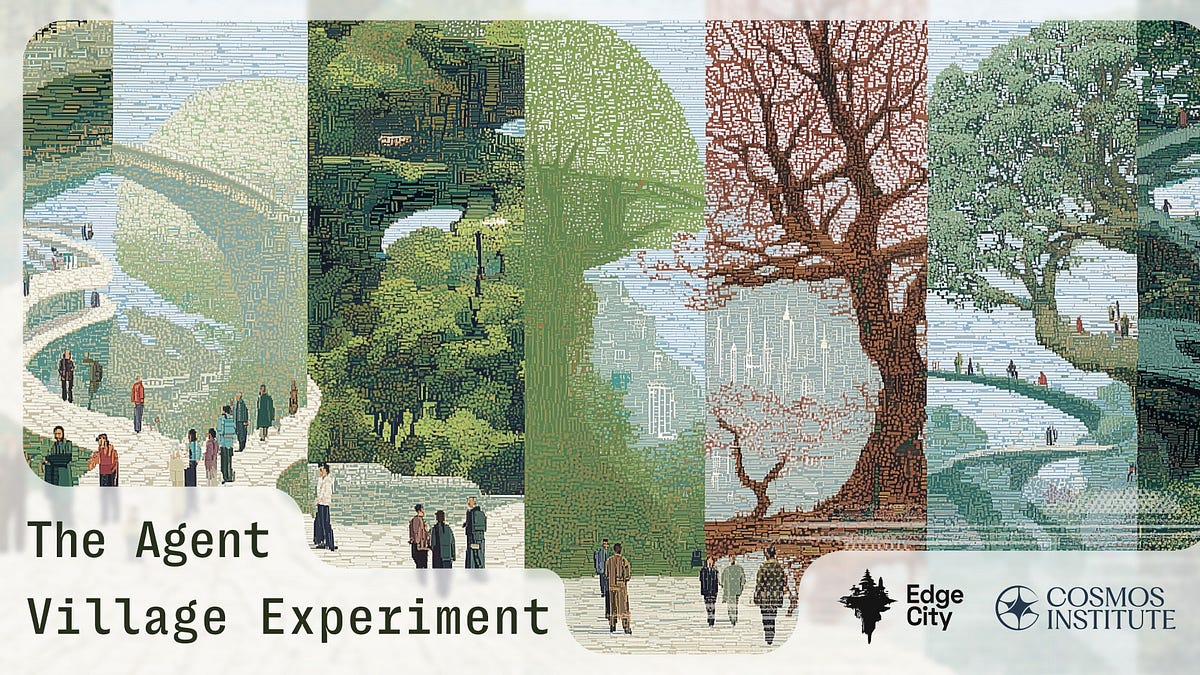


Insights
Exploring the frontiers of computing, networking, and knowledge systems to build infrastructure that empowers humanity.
Adam Marblestone — We Are Massively Underinvesting in the Human Brain
Juan Benet speaks with Adam Marblestone, CEO and co-founder of Convergent Research, about why neurotech, whole-brain emulation, and nanotech are limited by capital and coordination rather than ideas, why connectomics is the approach most poised to scale, what a full wiring diagram of the brain would unlock for disease and AI, and how far mind uploading really is from the fringe of science.
We Gave a Village Personal AI Agents. Here's What Happened↗
Edge City and Cosmos Institute gave 239 residents of Edge Esmeralda personal AI agents. Through Simocracy (led by Protocol Labs), residents created 82 Sims with constitutions and values that allocated over $10k in community treasury funding across 35 proposals — an early glimpse of agent-mediated governance.
Programmable Economies & Governance: Upgrading Society's Operating System
An overview of PL R&D's Programmable Economies & Governance focus area — the programmable infrastructure societies use to decide, allocate, verify, and coordinate — and the four opportunity spaces and inflection points we believe are within reach.
Allison Duettmann — Why We Don't Have to Die: Cryonics, Uploading, and Existential Hope
Juan Benet speaks with Allison Duettmann, CEO of the Foresight Institute, about why cryonics and mind emulation could mean we don't have to die, how whole-brain emulation and connectomics could keep humans compatible with superintelligent AI, how nanotechnology could rebuild the physical world, and the case for Existential Hope — imagining flourishing futures as a precondition for building them.
How PL R&D Accelerates Breakthroughs
The first in a series: how PL R&D moves frontier ideas from open research into deployed systems across four focus areas — how we drive, measure, and sustain breakthroughs, and what our track record teaches us.
Can Quadratic Funding Go Mainstream? Ma Earth, Hypercerts & the Future of Public Goods
Kevin Owocki sits down with Matthew Monahan (Ma Earth) and Holke Brammer (Hypercerts Foundation) to discuss a bold new experiment: a $1 million Quadratic Funding round designed to bring public goods funding beyond the crypto ecosystem and into the mainstream.
Konrad Kording — The Power of a Single Neuron and a Path to Simulating the Brain
Juan Benet speaks with Konrad Kording of the University of Pennsylvania about the surprising computational power of a single neuron, reading the brain's wiring down to molecular detail, and building compilers and simulations as a path toward understanding — and ultimately simulating — the brain.
Tom Oxley — Reading the Brain Without Opening the Skull
Juan Benet speaks with Tom Oxley, co-founder and CEO of Synchron, about the Stentrode — a brain-computer interface that reaches the motor cortex through a blood vessel without opening the skull — restoring independence to people with motor impairment and the path toward higher-channel-count neural interfaces.
Jacques Carolan — The Mission to Get Breakthrough Brain Treatments to Everyone
Juan Benet speaks with Jacques Carolan, a founding Programme Director at ARIA, about getting breakthrough brain treatments to everyone, how ambitious science programs can accelerate neurotechnology, and what it takes to move hard neurotech ideas toward patient impact.
Ben Rapoport — Treating Paralysis and Digitizing Brain Data
Juan Benet speaks with Ben Rapoport of Precision Neuroscience about treating paralysis, building scalable brain-computer-interface platforms, and how high-quality neural data can transform both clinical care and computational neuroscience.
How to Obtain a Complete Human Connectome at Synaptic Resolution Within the Next Decade
Announcing the Juan Benet Podcast: Launching With First Guest Max Hodak, CEO of Science Corp↗
Juan Benet Podcast launches with Max Hodak on neurotech, brain interfaces, Fast R&D, and more.